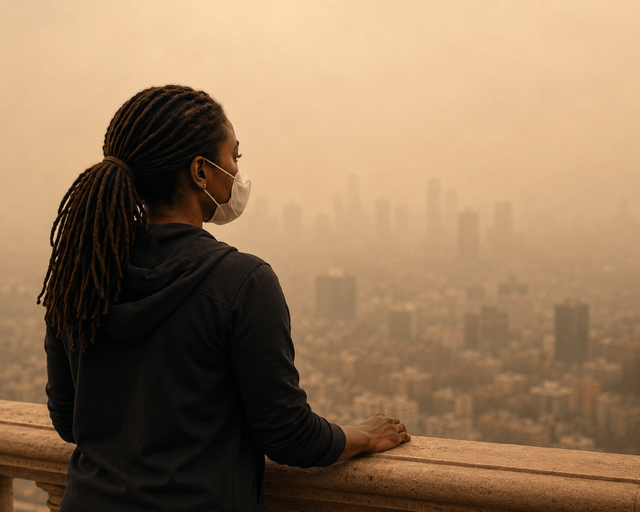
I recently attended a business-related conference in NYC. As I watched the haze sit low over Times Square, I had this thought I couldn’t shake: we talk so much about what we put IN our hair, but almost nothing about what our hair is pulling OUT of the air.
As a loctician, I spend my weekends with my hands in people’s heads. And what I’ve learned after over a decade of work is that locs behave much like air filters! Locs naturally trap dust, pollen, smoke particles, and other environmental debris over time. Every loc (and strand) is catching something - whatever’s floating around that day - and it doesn’t just brush off. It settles in. Layer by layer. And if you’re not clarifying properly, it stays.
How Air Pollution Affects Locs Year-Round
Last year, I was featured in an Essence piece talking about post-summer scalp detox - the buildup that happens from sweat, protective styles, and product layering over a hot season. That conversation was really about one core truth: your scalp and hair are porous, and it’s absorbing more than we give it credit for. Air pollution and its effects on locs cannot be denied.
Poor air quality - the kind we are experiencing now - from wildfire smoke drifting in from Canada, impacts not only our health, but our hair. High-pollen days, urban pollution, or even just a dry, dusty stretch of weather can contribute to what’s sitting within our locs. It’s not always visible. You won’t always see it the way you see product residue. But trichologically speaking, particulate matter can settle into the hair shaft and scalp, contribute to irritation, and inhibit the flow of oxygen- exactly when your scalp needs to breathe.
Why “Residue-Free” Isn’t Just a Buzzword to Us
This is exactly why we built NVLX Labs. We never wanted to create products that added to the problem: more coating, more residue, more stuff sitting on top of what your hair is already absorbing from the environment. Everything we formulate is clean, water-soluble, and residue-free on purpose. When you shampoo your locs, you’re actually getting a clean reset. Not fighting product buildup on top of environmental buildup.
Clarifying isn’t about stripping your hair or being harsh with your locs. It’s about giving your scalp the chance to breathe again- especially after days when the air wasn’t doing your hair any favors.
A Simple Truth (With This Week’s Air in Mind)
You can’t control the air quality index on any given day. What you can control is how often you check in with your scalp and what you’re using to reset it.
This week, New York City’s Air Quality Index was forecast to hit around 200 - which is classified as “Unhealthy” for everyone, not just sensitive groups. This rating was driven by fine particulate matter (PM2.5) from the Canadian wildfire smoke. PM2.5 particles are small enough to bypass nasal defenses and lodge deep in the respiratory tract. These same particles lodge themselves onto the scalp and within your locs. They contribute to microscopic grit, oxidative stress, and that “tight, itchy, heavy” feeling.
If your scalp feels tight, itchy, or like your hair just isn’t moving the way it used to - it might not be about what you put in your hair (product-wise). It might just be about what your hair’s been breathing in.
Concerned about environmental build-up? Explore our residue-free clarifying shampoo, designed to remove buildup (without stripping) while leaving no residue behind.
Clarify with intention. Your locs will thank you.
FAQs
Does air pollution affect locs?
Yes. Locs naturally trap dust, pollen, smoke particles, and other airborne pollutants as you move through your environment. Over time, these particles can contribute to buildup, scalp irritation, and dull-looking locs if they aren’t removed through regular cleansing.
Can wildfire smoke get trapped in locs?
Yes. Wildfire smoke contains microscopic particles (PM2.5) that can settle onto the hair and scalp. While the buildup isn’t always visible, prolonged exposure may leave your locs feeling dry, heavy, or itchy, making regular clarifying especially important.
How often should you clarify locs?
Most people with locs benefit from clarifying every 4-6 weeks. However, if you’re exposed to poor air quality, pollen, frequent workouts, or use styling products regularly, you may need to clarify more often. Your ideal routine should reflect your environment and lifestyle.
What causes buildup in locs besides hair products?
Product residue is only one source of buildup. Locs can also collect and trap air pollution, wildfire smoke, pollen, dust, sweat, hard-water minerals, lint, shed skin, and natural scalp oils. Regular cleansing helps remove both environmental and product-related buildup to support a healthier scalp.
Why should you use a residue-free shampoo for locs?
A residue-free shampoo is designed to rinse clean without leaving ingredients behind. For people with locs, this helps remove environmental buildup, excess oil, and impurities without adding residue that can become trapped in the hair over time. Having a shampoo that clarifies without stripping is essential.